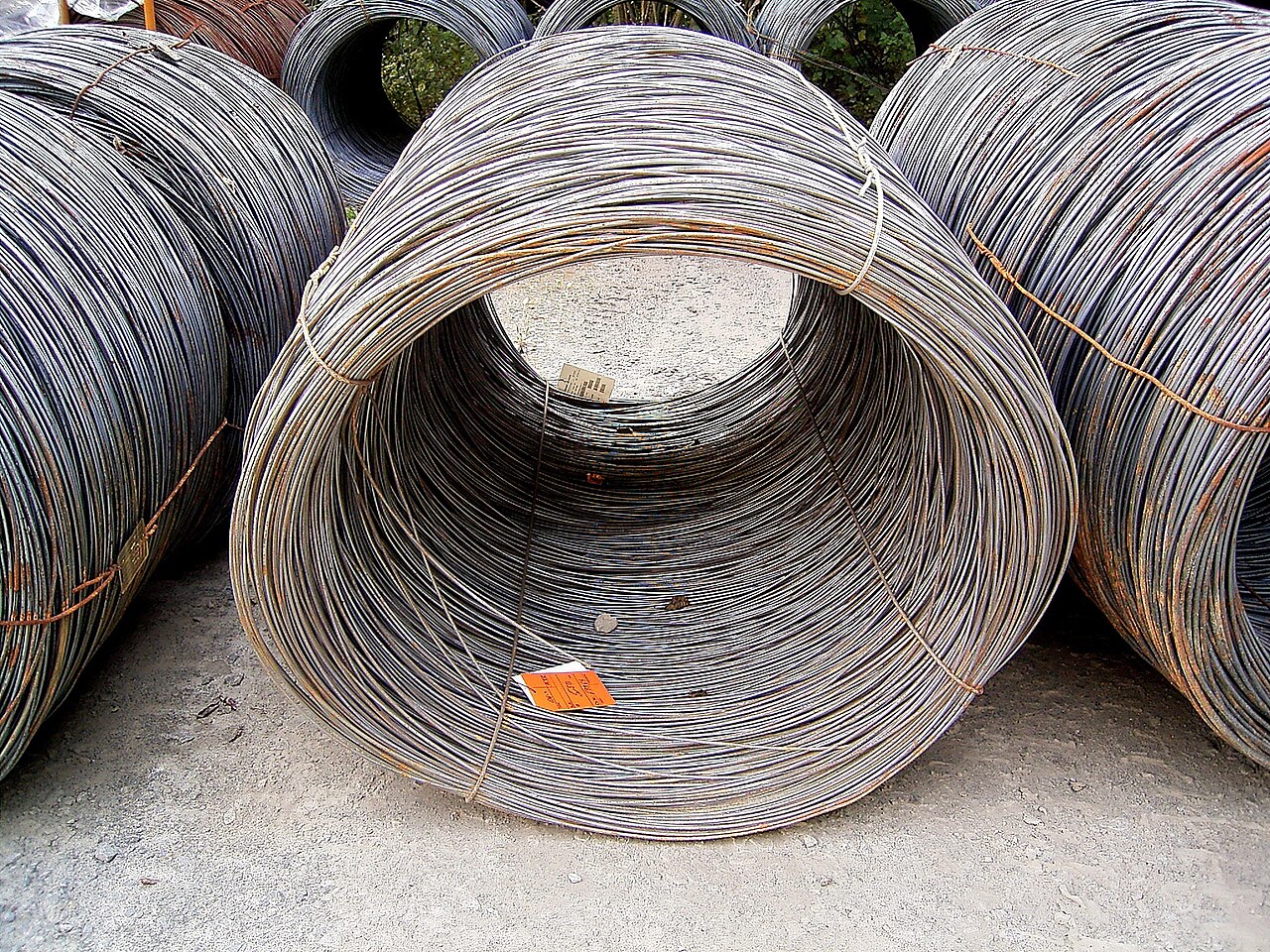
High carbon steel wire, also known as hard wire, contains between 0.60 and 1.00 percent carbon. The elevated carbon content raises hardness, tensile strength and wear resistance while reducing ductility and weldability — the trade-off that defines its role in structural and dynamic applications.
Chemistry and grades
The base composition is 0.60–1.00 % C, 0.30–0.90 % Mn and up to 0.30 % Si. Sulphur and phosphorus are held below 0.025 % in clean steel practice, because both elements create stress concentrators that cause breakage during drawing. Common AISI grades are 1060, 1070, 1080 and 1090; grade selection depends on final diameter, total area reduction and the required strength level.
Mechanical properties
- Tensile strength: 700–900 MPa in hot-rolled rod; 1,400–2,000 MPa after patenting and cold drawing; up to about 2,500 MPa for music wire.
- Hardness and wear resistance: far above low carbon wire, suited to abrasive and fatigue-loaded surfaces.
- Spring quality: high elastic limit and shape retention after unloading.
- Limited ductility: requires minimum bend radii and tight control during forming.
Manufacturing process
Production starts from 5.5–14 mm wire rod: pickling removes mill scale, a base coating such as zinc or iron phosphating or borax carries the lubricant, multi-pass cold drawing reduces the section, patenting (lead bath or fluidised bed) develops fine pearlite, and final drawing sets the strength. Every pass raises strength and loads the die, so tungsten carbide dies and a stable lubricant film directly govern breakage rate and surface quality.
Common applications
- Springs: compression, tension and torsion springs to ASTM A228 (music wire) and ASTM A229 (oil-tempered).
- Prestressed concrete strand: low-relaxation strand to ASTM A416.
- Wire rope and cable: high-strength strands for hoisting, cranes and bridges.
- Tyre industry: bead wire and brass-plated tyre cord for rubber adhesion.
- Specialty uses: stone cutting wire, brush wire, fish hooks and needles.
Production challenges
Surface decarburisation during hot rolling, brittle fracture in drawing, die wear, residual stress and hydrogen embrittlement after pickling are the five main issues. Hydrogen embrittlement is controlled by baking at about 200 °C after plating, and residual stress is balanced through patenting and final drawing.
Quality control and standards
Testing includes tensile tests for strength and elongation, torsion tests to reveal longitudinal cracks, wrap and knot tests for ductility, and coating mass measurement in g/m². Reference standards are ASTM A228, A229, A416 and A510, ISO 6931-1 and ISO 16120. For the softer alternative, see low carbon steel wire.
Patenting: the metallurgy at the heart of high carbon wire
Patenting is the dedicated heat treatment of this family: the wire is austenitised at about 900–1000 °C and then quenched into molten lead at 500–550 °C or a fluidised bed to form fine, uniform pearlite (sorbite). The resulting structure combines strength with the ductility needed for the next drawing pass; without it, high carbon wire fractures in the first passes. Intermediate patenting repeats between passes, up to three times for fine wire. Environmental restrictions on lead have pushed the industry toward fluidised beds and salt baths.
Area reduction and die selection
Total area reduction is typically 80–90 %, with 15–25 % per pass. Excessive reduction in one pass drives drawing stress beyond the wire’s capacity and causes breakage; too little raises pass count and cost. Die approach angle, bearing length, polish quality and lubricant viscosity together determine the speed and surface finish obtained.
Coatings and corrosion protection
High carbon wire corrodes readily in humid and industrial environments, so coating choice defines service life. Hot-dip galvanising at 200–300 g/m² is used for bridge stay cables and exposed structures; zinc-5 % aluminium alloy significantly improves corrosion resistance in chloride-bearing atmospheres; brass plating is essential for tyre cord adhesion to rubber; and epoxy coating on prestressing strand delivers corrosion protection together with fatigue performance. Every coating is a trade-off: thicker, harder coatings raise corrosion resistance but reduce fatigue resistance.
Summary
High carbon wire quality is set from steelmaking through patenting and final drawing. Chemistry control, stable heat treatment, and correct die and lubricant selection are the three levers for achieving high strength without losing ductility.