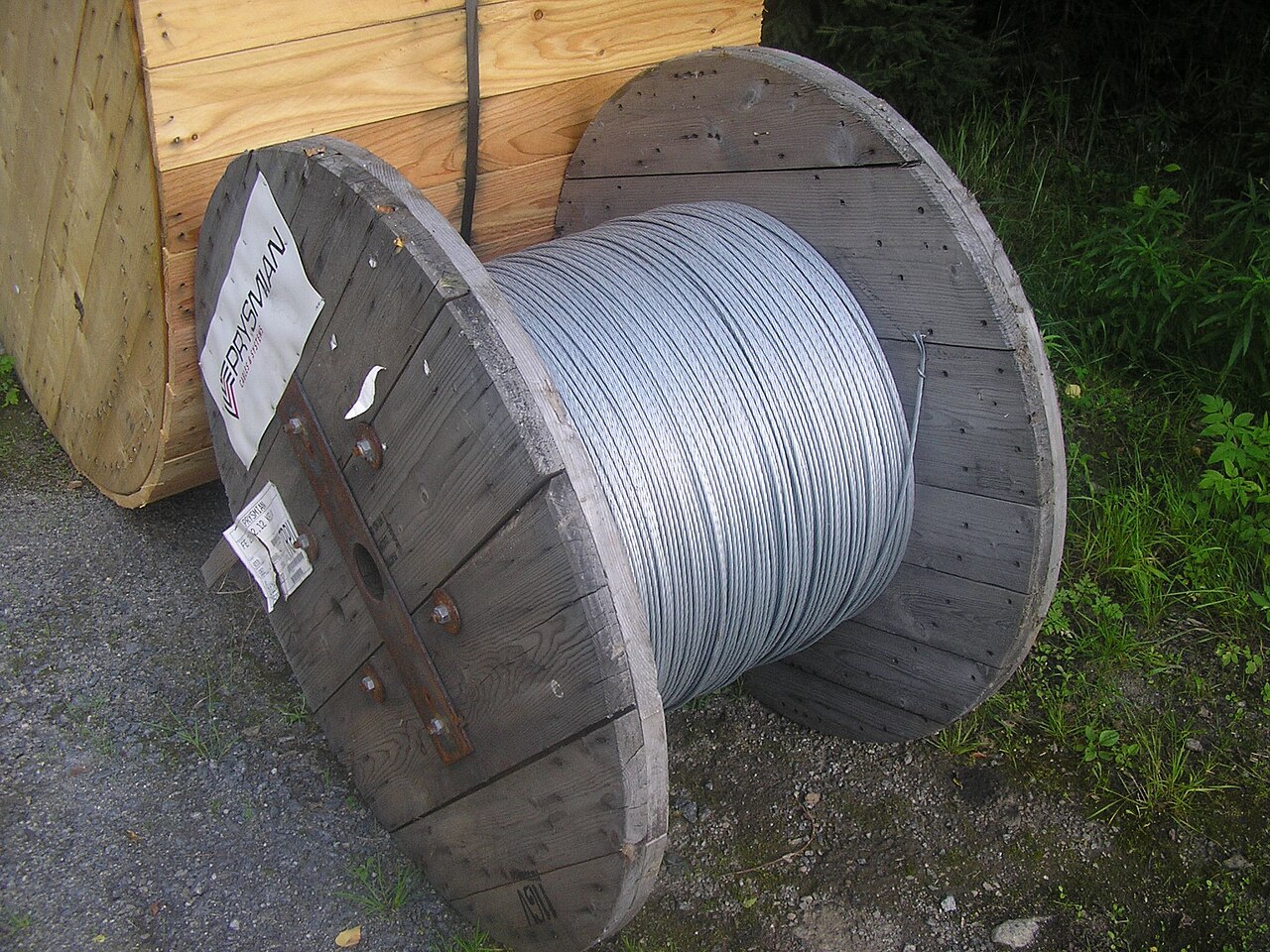
Low carbon steel wire, also called mild steel wire, contains less than 0.25 percent carbon. Its ductility, weldability and low cost make it the highest-volume product among steel wires, and the default choice wherever cold forming, bending and joining are required.
Chemistry and grades
The base is carbon below 0.25 %, manganese 0.30–0.60 % and controlled sulphur and phosphorus. Common grades are AISI 1005 to 1018, sheet grades SPCC and DC01, and ASTM A510 for rod. For galvanised products ASTM A641 defines coating classes, while EN 10016 specifies drawing stock requirements.
Mechanical properties
- Tensile strength: 300–500 MPa annealed and 500–800 MPa after cold drawing.
- Ductility: elongation up to 25 %; bending, riveting and deep forming without cracking.
- Weldability: excellent, with no preheat needed at conventional thicknesses.
- Surface quality: suitable for plating, painting and polymer coating.
Manufacturing process
The route is pickling, cold drawing, annealing to restore ductility, and galvanising when required. Annealing runs in a controlled atmosphere or continuous furnace to minimise surface oxidation. Before drawing, a phosphate or lime base coating carries the lubricant and extends die life.
Industrial applications
- Construction: reinforcement mesh, rebar tying wire and welded mesh.
- Fasteners: nails, screws, rivets and cold-heading parts.
- Fencing and agriculture: chain-link, barbed wire and baling wire.
- Automotive: clamps, clips, brackets and non-structural components.
- Welding consumables: the core of CO2 welding wire is drawn from this grade.
Galvanising and coatings
Hot-dip galvanising gives a thicker coating than electroplating and suits corrosive environments; coating mass is reported in g/m² with classes defined by ASTM A641. PVC coating is used for decorative and garden fencing.
Common defects
Excess work hardening in drawing, cracking during cold forming, orange-peel surface in deep forming, hydrogen embrittlement after pickling and plating, and zinc whiting on galvanised wire are the usual problems. Controlling area reduction, ensuring adequate annealing and baking after plating minimise all of them.
Cold heading and grade selection
In cold heading, grades 1008 and 1010 serve screws and rivets, while 1018 suits parts with high deformation. Spheroidise annealing turns carbides into spheres and lowers work hardening; heavy forming requires it. The strength-to-ductility ratio and the strain-hardening exponent n decide whether a part forms without cracking.
Economics and sustainability
Low carbon steel has the highest recycling share among metals, and its scrap remelts in electric arc furnaces without quality loss. Energy per tonne of drawn wire, annealing-cycle optimisation and acid regeneration in the pickling line are the three main levers for cost and environmental impact.
Specification checklist
Before ordering, fix five parameters: diameter and tolerance (typically ±0.05 mm for precision work), strength class or annealed condition, zinc coating mass in g/m², surface finish (bright, annealed, galvanised) and coil weight. Knowing the end use simplifies grade choice: rebar tying needs only a soft, low-cost grade; cold-heading screws need higher carbon with spheroidise annealing; and fencing in humid climates requires hot-dip galvanising.
Market outlook
Global low carbon wire demand grows with construction and infrastructure spending in Asia and Africa. Regulatory pressure on pickling effluent and zinc consumption is pushing producers toward acid regeneration and low-consumption coatings — a factor that will reshape the cost structure of the industry in the medium term.
Typical defects and their causes
Surface cracking after heading points to insufficient spheroidise annealing or a grade with too much carbon; slivers and seams come from rolled-in scale or a worn die; and uneven zinc pickup usually traces to poor pickling rinse or bath chemistry drift.
Quality control and summary
Tensile, bend, torsion and coating-mass tests form the core inspection set. Low carbon wire is the base grade of the wire industry: inexpensive, reliable and formable, with final quality driven mainly by annealing and surface control. For the high-strength alternative see high carbon steel wire.
Pingback: CO2 Welding Wire: Complete Guide to MIG/MAG Welding - MIG/MAG | تولیدکننده سیم جوش و مفتول فولادی