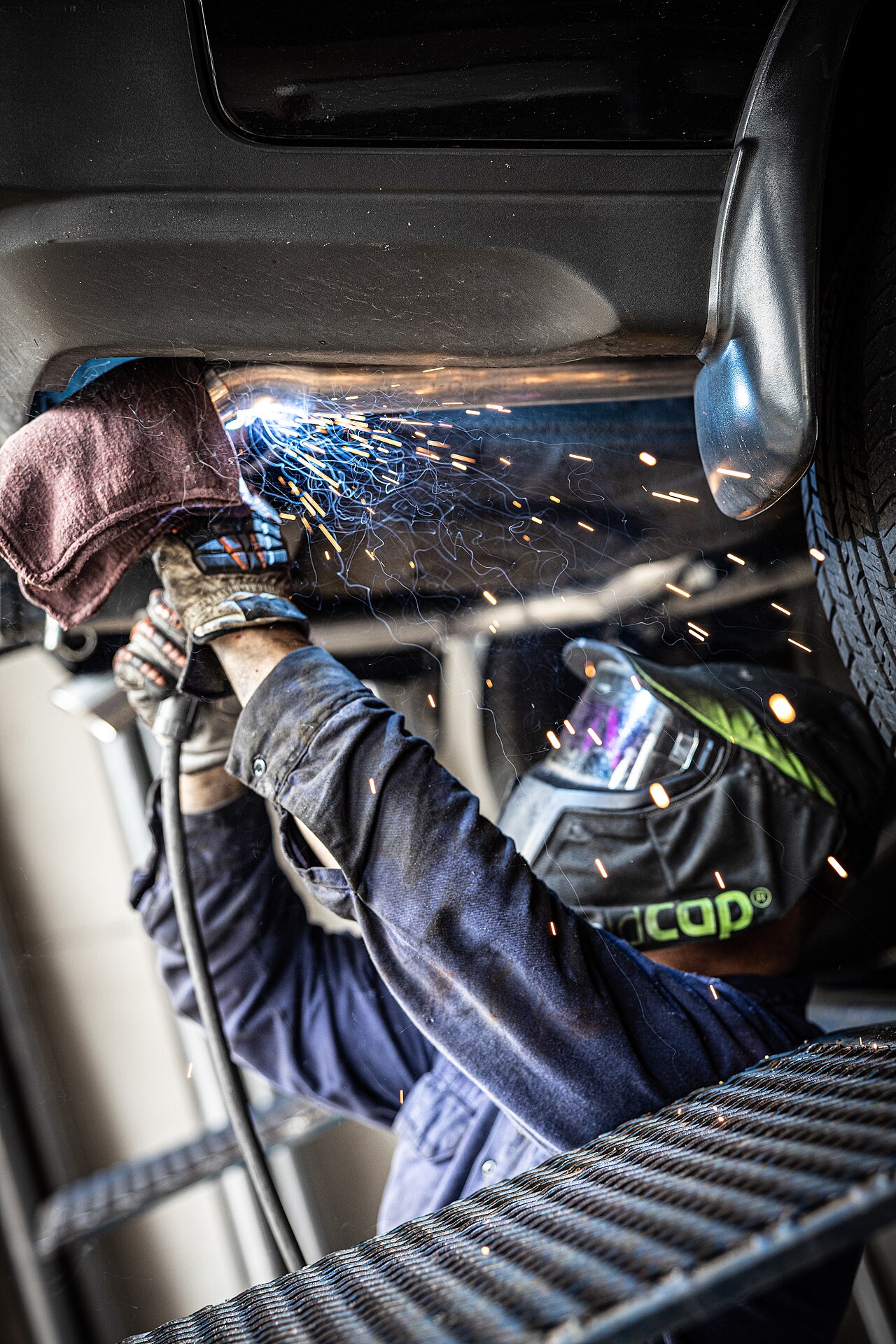
CO2 welding wire is the most consumed consumable in MIG/MAG welding — GMAW — where a continuous wire electrode feeds into the weld pool while shielding gas keeps the molten metal free of atmospheric contamination. High deposition rate, continuous welds and robotic compatibility have made it the backbone of structural steelwork, automotive assembly and shipbuilding.
Standards and grades
The governing standards are AWS A5.18 and its international equivalent ISO 14341. The most widely used grade is ER70S-6 (G3Si1) with 1.40–1.85 % Mn and 0.80–1.15 % Si; the high manganese and silicon deoxidise the pool and make the weld tolerant of rust and surface contamination. ER70S-3 (G2Si1) with lower Mn and Si suits clean plate and calmer welds. ER80S-D2 adds 0.5 % Mo for higher strength, and ER100S-1 serves high-strength steels and critical joints.
Alloying role and copper coating
Low carbon (0.06–0.15 %) ensures ductility and crack resistance, while sulphur and phosphorus are held below 0.025 % to avoid solidification cracking. A thin copper coating (about 0.15–0.35 % of wire mass) lowers friction in the feed system, improves electrical contact and slows rusting.
Shielding gas and parameters
- Pure CO2: deep penetration and low cost, but more spatter and a rougher bead.
- 82 % Ar / 18 % CO2 (M21): less spatter, smoother and more stable arc — the usual choice for robotic welding.
- Current and voltage: about 180–280 A and 18–26 V for 1.2 mm wire.
- Wire feed speed: 4–12 m/min with 10–15 mm stick-out.
- Polarity: DCEP (electrode positive) in all standard modes.
Wire diameter versus plate thickness
0.8 mm suits 0.8–3 mm sheet, 1.0 mm covers 3–6 mm, 1.2 mm handles 6–12 mm and 1.6 mm is used above 12 mm. The wrong diameter produces either lack of fusion or burn-through and distortion.
Storage and common defects
Wire must stay in sealed packaging in a dry store; surface moisture introduces hydrogen and raises the risk of cold cracking. Porosity, excess spatter, lack of fusion, undercut and wormholes are the usual defects, and most trace back to surface contamination, wrong parameters or damp gas. Diffusible hydrogen levels are designated H4, H10 and H15 in the relevant standards.
Applications
Steel structures, vehicle chassis, ship hulls, tanks, industrial repair and robotic welding lines are the five main markets. The wire core is drawn from low carbon steel wire, and drawing quality and die condition directly affect feed consistency and arc stability.
Health and safety
Welding fume carries manganese particles, metal oxides and — in stainless steel — hexavalent chromium, so local exhaust ventilation at the arc and a matched respirator are a legal requirement, not an option. The arc emits intense ultraviolet radiation: a shade 10–13 helmet, leather gloves and flame-resistant clothing are mandatory. EN ISO 15012-1 classifies extraction equipment, and confined spaces require gas monitoring and a formal entry permit.
Compared with stick electrodes
Solid wire is continuous, so there is no downtime for electrode changes; the result is higher duty cycle, higher deposition rate and less waste. Against that, the equipment costs more, the arc is sensitive to draughts outdoors and shielding gas is required. For field repair and small workshops stick welding remains simpler; for volume production and robotic lines solid wire has no rival.
Cost and efficiency
Wire is only part of the welding cost; labour, rework and downtime usually dominate. Deposition efficiency — the share of wire that becomes usable weld metal — falls with spatter, so a slightly dearer low-spatter wire on an M21 mix can be cheaper per metre of finished weld. Contact tips and liners are the hidden consumables: a worn liner causes feed fluctuation, arc instability and porosity.
Summary
Correct grade, gas and parameter selection determine about 80 % of weld quality; the remaining 20 % depends on wire health — dryness, coating, diameter consistency — and base metal cleanliness. For related wire products see the iron wire industry.